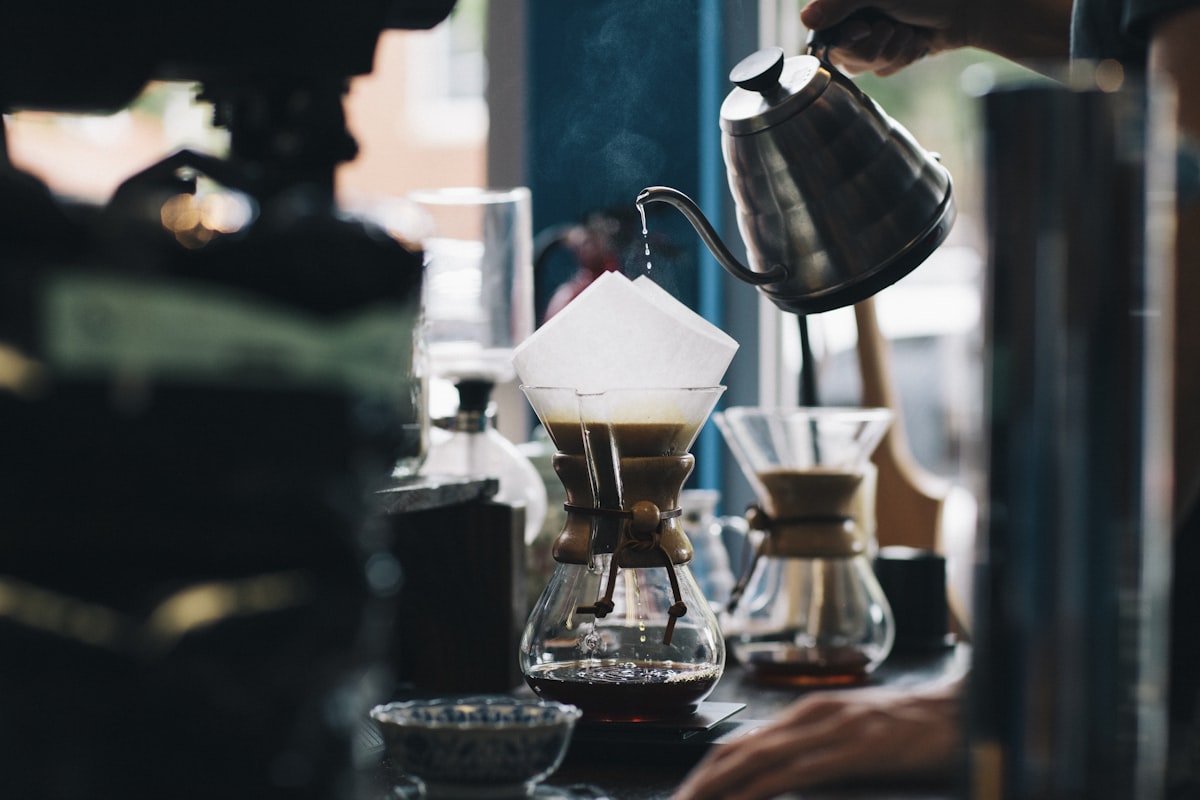
The phrase third wave coffee gets thrown around so loosely that it has nearly lost its meaning. To some, it’s a marketing term for any coffee shop with a minimalist logo and white tile. To others, it’s a specific historical movement with founders, manifestos, and consequences. The truth is closer to the second one, and the story is worth knowing if you care about the coffee in your cup today.
What the waves actually refer to
The wave metaphor was popularized by Trish Rothgeb in 2002, when she wrote an article in The Roasters Guild’s newsletter that named the movement she was watching unfold. The waves work like this:
First wave was the post-war commodity boom: Folgers, Maxwell House, instant coffee, the rise of coffee as a household staple in nearly every American home. Coffee was a beverage, not a craft. Quality varied wildly and few drinkers noticed.
Second wave began in the 1960s and 70s with Peet’s in Berkeley and ran through the explosive growth of Starbucks in the 1990s and 2000s. Second wave introduced espresso drinks, dark roasts, and the cafe as a third place. Origin still mattered less than blend; quality was about consistency at scale.
Third wave emerged in the early 2000s as a small group of roasters and cafes pushed back against the homogenization of the second wave. They wanted to know which farm a coffee came from, who picked it, how it was processed, and how to roast it to express that specificity rather than mask it.
The founding cafes and roasters
A few names dominate the early third wave history:
- Stumptown (Portland, 1999): Direct-trade green sourcing, light roasts, dedication to single-origin transparency.
- Intelligentsia (Chicago, 1995): Pioneered the Direct Trade certification, formalizing relationships with specific farms.
- Counter Culture (Durham, 1995): Heavy investment in barista training and origin education.
- Tim Wendelboe (Oslo, 2007): Pushed light roasts, washed processing, and Nordic precision into the global conversation.
- Coffee Collective (Copenhagen, 2007): Co-founded by World Barista Champion Klaus Thomsen, brought competition-level brewing to a retail context.
- Square Mile (London, 2008): James Hoffmann’s roastery, which became the European reference point for what third wave coffee should taste like.
What third wave actually changed
The lasting impact of the third wave wasn’t a single product or technique. It was a shift in what coffee was assumed to be. A few specific changes that the movement embedded into the global coffee culture:
Single-origin became normal. A bag listing a specific farm and washing station, rather than just a country, was exotic in 2005 and standard in 2026.
Light roasting became respected. The second wave assumed darker was better. The third wave demonstrated that lighter roasts could express origin character that disappeared at darker roast levels.
Brewing methods diversified. Pour-over, AeroPress, Chemex, siphon, and other manual methods were marginal in cafes before 2005. They became standard offerings as the movement valued the cafe as a place to taste rather than to caffeinate.
The barista became a craftsman. Wages rose, training programs formalized, the World Barista Championship became a serious competitive circuit, and “barista” became a respected job title in many markets.
Direct trade and traceability became expected. Specialty buyers built direct relationships with farms, often visiting and forming long-term partnerships, in contrast to the commodity broker model that dominated previously.
The third wave plateau
Around 2018-2020, the movement clearly plateaued in many markets. The cafes that defined the wave reached their cultural saturation point. The minimalist white-tile aesthetic became a cliche. Younger drinkers raised on third wave norms started to find some of the dogmas (no flavored drinks, no oat milk in your espresso, no compromises on light roast) more annoying than meaningful.
This plateau wasn’t a failure. It was the natural maturation of any movement that grows from outsider to mainstream. By 2020, third wave practices had become the new baseline, and the next conversation was about what came next.
What’s coming after
There’s no consensus on what to call the next wave, but several themes are emerging:
Hospitality is back in fashion. The aloof barista era is ending. Cafes that combine third wave technical competence with warm, accessible hospitality (rather than the implicit gatekeeping of the early third wave) are growing fastest.
Inclusive menus. The dogma against flavored drinks, alternative milks, and cold brew has softened. The best new cafes serve great espresso to the espresso obsessive and a great oat-milk vanilla latte to the person who wants one, without judgment in either direction.
Producer-side conversations. The third wave told the story of farms in the abstract. The next conversation is more grounded: how do farmers actually capture more value, what do living wages look like across the supply chain, and how does the industry adapt to climate-driven origin shifts.
Fermentation experimentation. Anaerobic naturals, co-fermentation, lactic processing, and other producer-side experiments are pushing flavor boundaries in ways the early third wave didn’t anticipate.
The retail-centric model is being questioned. Subscription services, RTD coffee, and direct-from-roaster relationships are challenging the assumption that the cafe is the central institution of specialty coffee.
What it means for you, the drinker
You don’t have to care about the wave terminology to benefit from the third wave’s legacy. The bag of coffee on your shelf is almost certainly better, more transparently sourced, and roasted with more skill than the equivalent bag from twenty years ago. The cafe you walk into is more likely to serve a great cup, regardless of whether it markets itself as third wave or not. The brewing methods you use at home are more likely to produce something memorable.
The third wave gave us all of that. The next wave, whatever it ends up being called, is being built on top of it.